Stash
Lightweight key-value configuration service for centralized config management. Store application settings, feature flags, and shared configuration with a simple HTTP API and web UI. A minimal alternative to Consul KV or etcd for microservices and containerized applications that need a straightforward way to manage configuration without complex infrastructure. Not a secrets vault - see Security Note.
Quick Start
# run with docker
docker run -p 8080:8080 ghcr.io/umputun/stash

# set a value
curl -X PUT -d 'hello world' http://localhost:8080/kv/greeting

# get the value
curl http://localhost:8080/kv/greeting

# delete the key
curl -X DELETE http://localhost:8080/kv/greeting
Web UI available at http://localhost:8080
Features
- HTTP API for key-value operations (GET, PUT, DELETE)
- Web UI for managing keys (view, create, edit, delete)
- SQLite or PostgreSQL storage (auto-detected from URL)
- Hierarchical keys with slashes (e.g.,
app/config/database) - Binary-safe values
- Light/dark theme with system preference detection
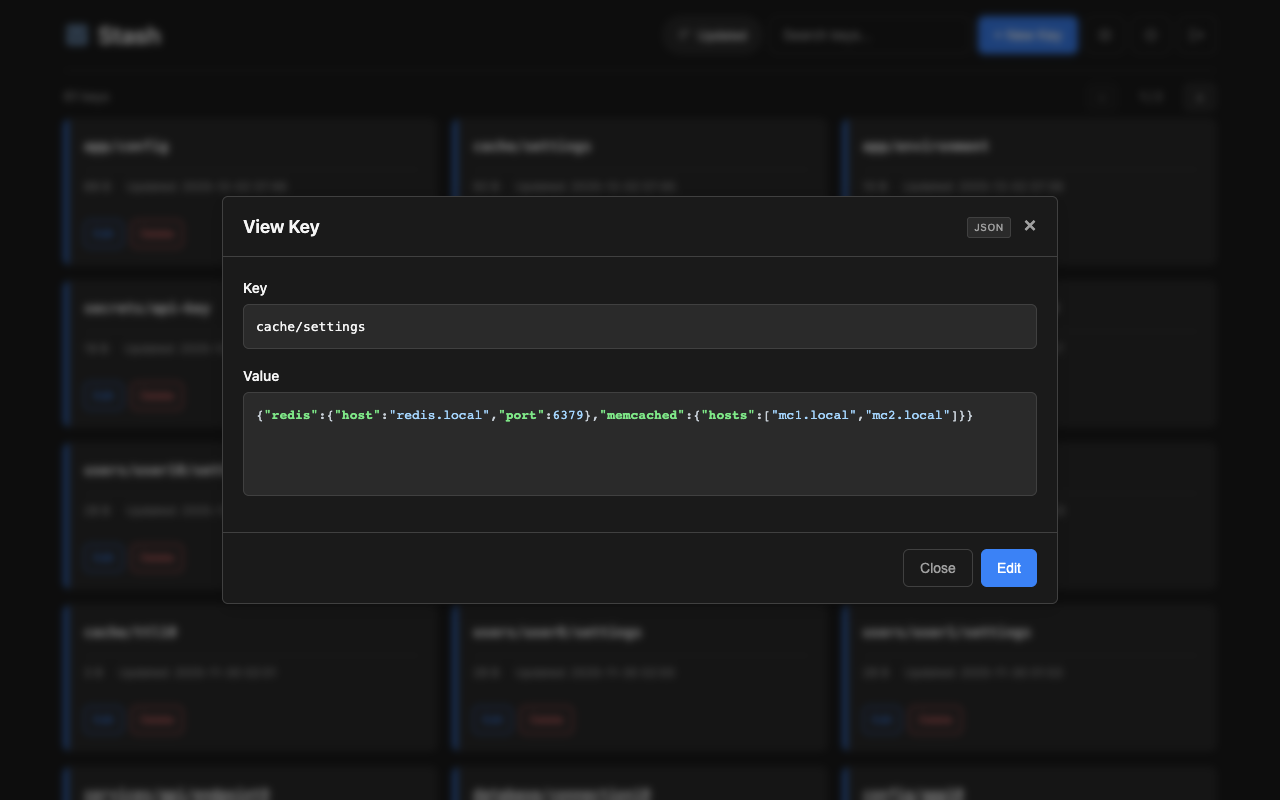
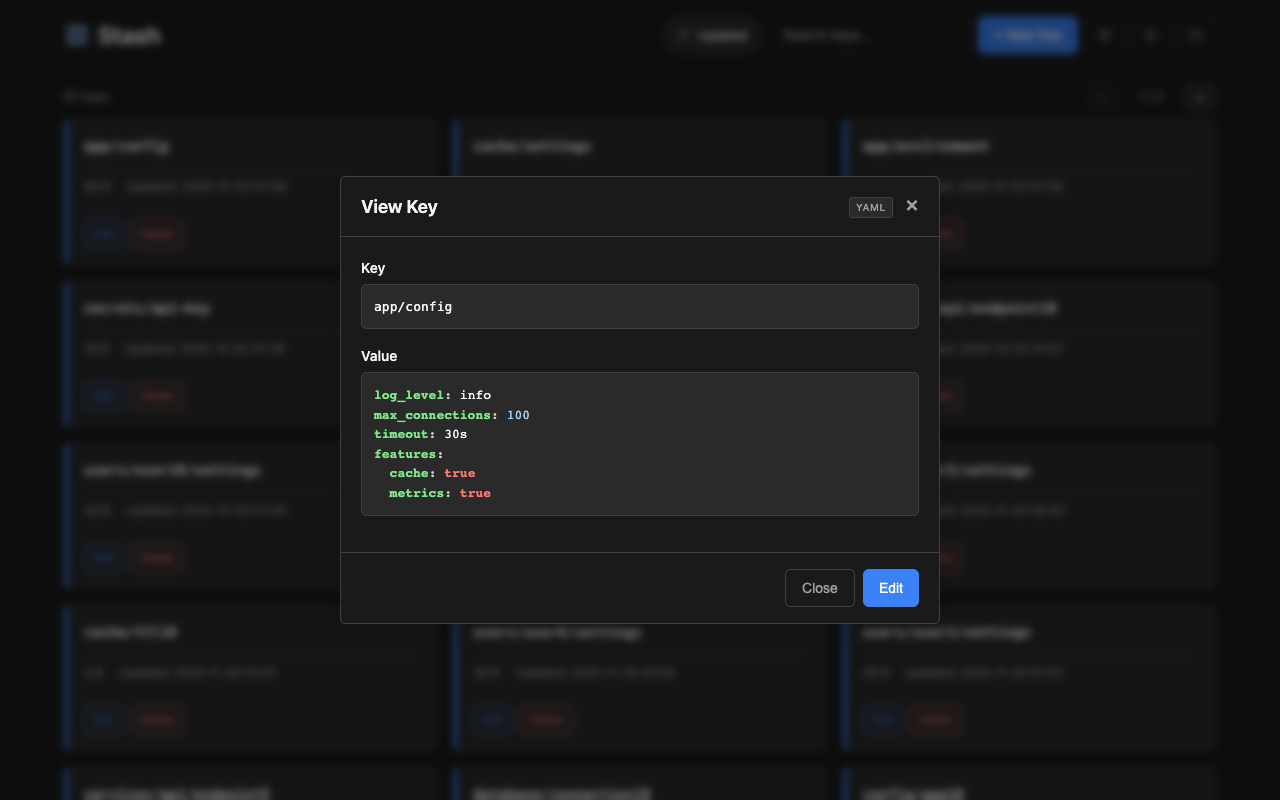
- Syntax highlighting for values (json, yaml, xml, toml, ini, shell)
- Optional authentication with username/password login and API tokens
- Prefix-based access control for both users and API tokens (read/write permissions)
- Optional git versioning with full audit trail and point-in-time recovery
- Optional in-memory cache for read operations
Security Note
Stash stores values in plaintext and is designed for application configuration, not secrets management. For sensitive credentials, consider:
- HashiCorp Vault or similar secrets managers
- Client-side encryption before storing values in Stash
- Filesystem-level encryption (LUKS, FileVault) for the database file
Installation
From GitHub Releases
Download the latest release for your platform from the releases page.
Homebrew (macOS)
Debian/Ubuntu (deb package)
wget https://github.com/umputun/stash/releases/latest/download/stash_<version>_linux_amd64.deb
sudo dpkg -i stash_<version>_linux_amd64.deb
RHEL/CentOS/Fedora (rpm package)
wget https://github.com/umputun/stash/releases/latest/download/stash_<version>_linux_amd64.rpm
sudo rpm -i stash_<version>_linux_amd64.rpm
Docker
Build from source
Usage
Stash uses subcommands: server for running the service and restore for recovering data from git history.
# SQLite (default)
stash server --db=/path/to/stash.db --server.address=:8080

# PostgreSQL
stash server --db="postgres://user:pass@localhost:5432/stash?sslmode=disable"

# With git versioning enabled
stash server --git.enabled --git.path=/data/.history

# Restore from git revision
stash restore --rev=abc1234 --db=/path/to/stash.db --git.path=/data/.history
Server Options
| Option | Environment | Default | Description |
|---|---|---|---|
-d, --db | STASH_DB | stash.db | Database URL (SQLite file or postgres://…) |
--server.address | STASH_SERVER_ADDRESS | :8080 | Server listen address |
--server.read-timeout | STASH_SERVER_READ_TIMEOUT | 5s | Read timeout |
--server.write-timeout | STASH_SERVER_WRITE_TIMEOUT | 30s | Write timeout |
--server.idle-timeout | STASH_SERVER_IDLE_TIMEOUT | 30s | Idle timeout |
--server.shutdown-timeout | STASH_SERVER_SHUTDOWN_TIMEOUT | 5s | Graceful shutdown timeout |
--server.base-url | STASH_SERVER_BASE_URL | - | Base URL path for reverse proxy (e.g., /stash) |
--server.page-size | STASH_SERVER_PAGE_SIZE | 50 | Keys per page in web UI (0 to disable pagination) |
--limits.body-size | STASH_LIMITS_BODY_SIZE | 1048576 | Max request body size in bytes (1MB) |
--limits.requests-per-sec | STASH_LIMITS_REQUESTS_PER_SEC | 100 | Max requests per second per client (rate limit) |
--limits.max-concurrent | STASH_LIMITS_MAX_CONCURRENT | 1000 | Max concurrent in-flight requests |
--limits.login-concurrency | STASH_LIMITS_LOGIN_CONCURRENCY | 5 | Max concurrent login attempts |
--auth.file | STASH_AUTH_FILE | - | Path to auth config file (enables auth) |
--auth.login-ttl | STASH_AUTH_LOGIN_TTL | 24h | Login session TTL |
--auth.hot-reload | STASH_AUTH_HOT_RELOAD | false | Watch auth config for changes and reload |
--cache.enabled | STASH_CACHE_ENABLED | false | Enable in-memory cache for reads |
--cache.max-keys | STASH_CACHE_MAX_KEYS | 1000 | Maximum number of cached keys |
--git.enabled | STASH_GIT_ENABLED | false | Enable git versioning |
--git.path | STASH_GIT_PATH | .history | Git repository path |
--git.branch | STASH_GIT_BRANCH | master | Git branch name |
--git.remote | STASH_GIT_REMOTE | - | Git remote name (for push) |
--git.push | STASH_GIT_PUSH | false | Auto-push after commits |
--git.ssh-key | STASH_GIT_SSH_KEY | - | SSH private key path for git push |
--dbg | DEBUG | false | Debug mode |
Restore Options
| Option | Environment | Default | Description |
|---|---|---|---|
--rev | - | (required) | Git revision to restore (commit hash, tag, or branch) |
-d, --db | STASH_DB | stash.db | Database URL |
--git.path | STASH_GIT_PATH | .history | Git repository path |
--git.branch | STASH_GIT_BRANCH | master | Git branch name |
--git.remote | STASH_GIT_REMOTE | - | Git remote name (pulls before restore if set) |
--dbg | DEBUG | false | Debug mode |
Database URLs
| Database | URL Format |
|---|---|
| SQLite (file) | stash.db, ./data/stash.db, file:stash.db |
| SQLite (memory) | :memory: |
| PostgreSQL | postgres://user:pass@host:5432/dbname?sslmode=disable |
Subpath Deployment
To serve stash at a subpath (e.g., example.com/stash), use --server.base-url:
The base URL must start with / and have no trailing slash. All routes, URLs, and cookies will be prefixed accordingly.
When using a reverse proxy, forward requests with the path intact (do not strip the prefix). Example reproxy configuration:
Authentication
Authentication is optional. When --auth.file is set, all routes (except /ping and /static/) require authentication.
Auth Config File
Create a YAML config file (e.g., stash-auth.yml) with users and/or API tokens. See stash-auth-example.yml for a complete example with comments.
users:
  - name: admin
    password: "$2a$10$..."  # bcrypt hash
    permissions:
      - prefix: "*"
        access: rw
  - name: readonly
    password: "$2a$10$..."
    permissions:
      - prefix: "*"
        access: r

tokens:
  - token: "a4f8d9e2-7c3b-4a1f-9e2d-8c7b6a5f4e3d"
    permissions:
      - prefix: "app1/*"
        access: rw
  - token: "b7e4c2a1-9d8f-4e3b-8a2c-1f7e6d5c4b3a"
    permissions:
      - prefix: "*"
        access: r
Start with authentication enabled:
Security: The auth config file contains password hashes and API tokens. Set restrictive file permissions:
Validation: The auth config is validated against an embedded JSON schema at startup. Invalid configs (wrong field names, invalid access values, etc.) will cause the server to fail with a descriptive error message.
Hot-Reload
Enable hot-reload to automatically pick up changes to the auth config file without restarting the server:
When the auth config file changes: - New users, tokens, and permissions take effect immediately - Sessions are selectively invalidated (only users removed or with password changes must re-login) - Invalid config changes are rejected and the existing config is preserved
Hot-reload watches the directory containing the auth file, so it works correctly with editors that use atomic saves (vim, VSCode, etc.).
Alternatively, send SIGHUP to trigger a manual reload without the --auth.hot-reload flag:
Session Storage
User sessions are stored in the database (same as key-value data), so they persist across server restarts. Expired sessions are automatically cleaned up in the background.
Generating Password Hashes
Access Methods
| Method | Usage | Scope |
|---|---|---|
| Web UI | Username + password login | Prefix-scoped per user |
| API | Bearer token | Prefix-scoped per token |
Users (Web UI)
Users authenticate via the web login form with username and password. Each user has prefix-based permissions that control which keys they can read/write.
API Tokens
Generate secure random tokens (use UUID or similar):
Use tokens via Bearer authentication:
curl -H "Authorization: Bearer a4f8d9e2-7c3b-4a1f-9e2d-8c7b6a5f4e3d" \
     http://localhost:8080/kv/app1/config
Warning: Do not use simple names like “admin” or “monitoring” as tokens - they are easy to guess.
Prefix Matching
*matches all keysapp/*matches keys starting withapp/app/configmatches exact key only
When multiple prefixes match, the longest (most specific) wins.
Permission Levels
rorread- read-only accessworwrite- write-only accessrworreadwrite- full read-write access
Public Access
Use token: "*" to allow unauthenticated access to specific prefixes:
This allows anonymous GET requests to public/* keys and the status key while still requiring authentication for all other keys.
Caching
Optional in-memory cache for read operations. The cache is populated on reads (loading cache pattern) and automatically invalidated when keys are modified or deleted.
When to Use Caching
- PostgreSQL deployments - Network latency to the database makes caching beneficial
- High read volume - Many clients frequently reading the same keys
- Read-heavy workloads - Configuration is read much more often than written
Caching is less useful for: - SQLite with local storage (already fast, file-based) - Write-heavy workloads (frequent invalidation negates cache benefits) - Keys that change frequently
Enabling Cache
How It Works
- First read of a key loads from database and stores in cache
- Subsequent reads return cached value (cache hit)
- Set or delete operations invalidate the affected key
- LRU eviction when cache reaches max-keys limit
Git Versioning
Optional git versioning tracks all key changes in a local git repository. Every set or delete operation creates a git commit, providing a full audit trail and point-in-time recovery.
Enabling Git Versioning
Storage Format
Keys are stored as files with .val extension. The key path maps directly to the file path:
| Key | File Path |
|---|---|
app/config/db | .history/app/config/db.val |
app/config/redis | .history/app/config/redis.val |
service/timeout | .history/service/timeout.val |
Directory structure example:
.history/
├── app/
│   └── config/
│       ├── db.val       # key: app/config/db
│       └── redis.val    # key: app/config/redis
└── service/
    └── timeout.val      # key: service/timeout
Remote Sync
Enable auto-push to a remote repository for backup:
# initialize git repo with remote first
cd /data/.history
git init
git remote add origin git@github.com:user/config-backup.git

# run with auto-push
stash server --git.enabled --git.path=/data/.history --git.remote=origin --git.push
When remote changes exist (someone else pushed), stash will attempt to pull before pushing. If there’s a merge conflict, the local commit is preserved and a warning is logged with manual resolution instructions.
Note: For local bare repositories on the same machine, use absolute paths (e.g., /data/backup.git). Relative paths like ../backup.git are not supported by the underlying git library.
Restore from History
Recover the database to any point in git history:
# list available commits
cd /data/.history && git log --oneline

# restore to specific revision
stash restore --rev=abc1234 --db=/data/stash.db --git.path=/data/.history
The restore command: 1. Pulls from remote if configured 2. Checks out the specified revision 3. Clears all keys from the database 4. Restores all keys from the git repository
API
Get value
Returns the raw value with status 200, or 404 if key not found.
Set value
Body contains the raw value. Returns 200 on success.
Optionally specify format for syntax highlighting via header or query parameter:
# using header
curl -X PUT -H "X-Stash-Format: json" -d '{"key": "value"}' http://localhost:8080/kv/config

# using query parameter
curl -X PUT -d '{"key": "value"}' "http://localhost:8080/kv/config?format=json"
Supported formats: text (default), json, yaml, xml, toml, ini, hcl, shell.
Delete key
Returns 204 on success, or 404 if key not found.
List keys
# list all keys
curl http://localhost:8080/kv/

# list keys with prefix filter
curl "http://localhost:8080/kv/?prefix=app/config"
Returns JSON array of key metadata with status 200:
[
  {"Key": "app/config/db", "Size": 128, "Format": "json", "CreatedAt": "...", "UpdatedAt": "..."},
  {"Key": "app/config/redis", "Size": 64, "Format": "yaml", "CreatedAt": "...", "UpdatedAt": "..."}
]
When authentication is enabled, only keys the caller has read permission for are returned.
Get key history
Returns JSON array of historical revisions (requires git versioning enabled). Returns 503 if git is not enabled.
[
  {
    "hash": "abc1234",
    "timestamp": "2025-01-15T10:30:00Z",
    "author": "admin",
    "operation": "set",
    "format": "json",
    "value": "eyJrZXkiOiAidmFsdWUifQ=="
  }
]
The value field contains base64-encoded content for each revision.
Health check
Returns pong with status 200.
Web UI
Access the web interface at http://localhost:8080/. Features:
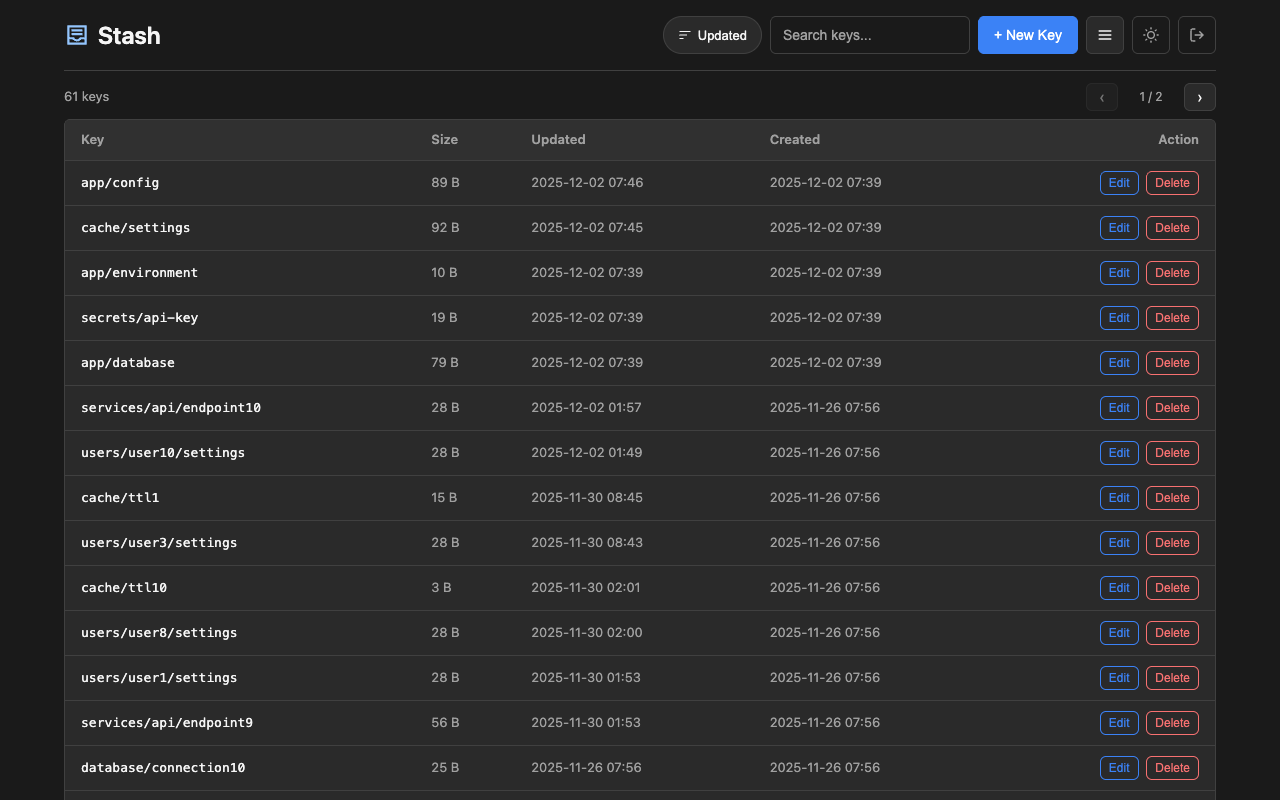
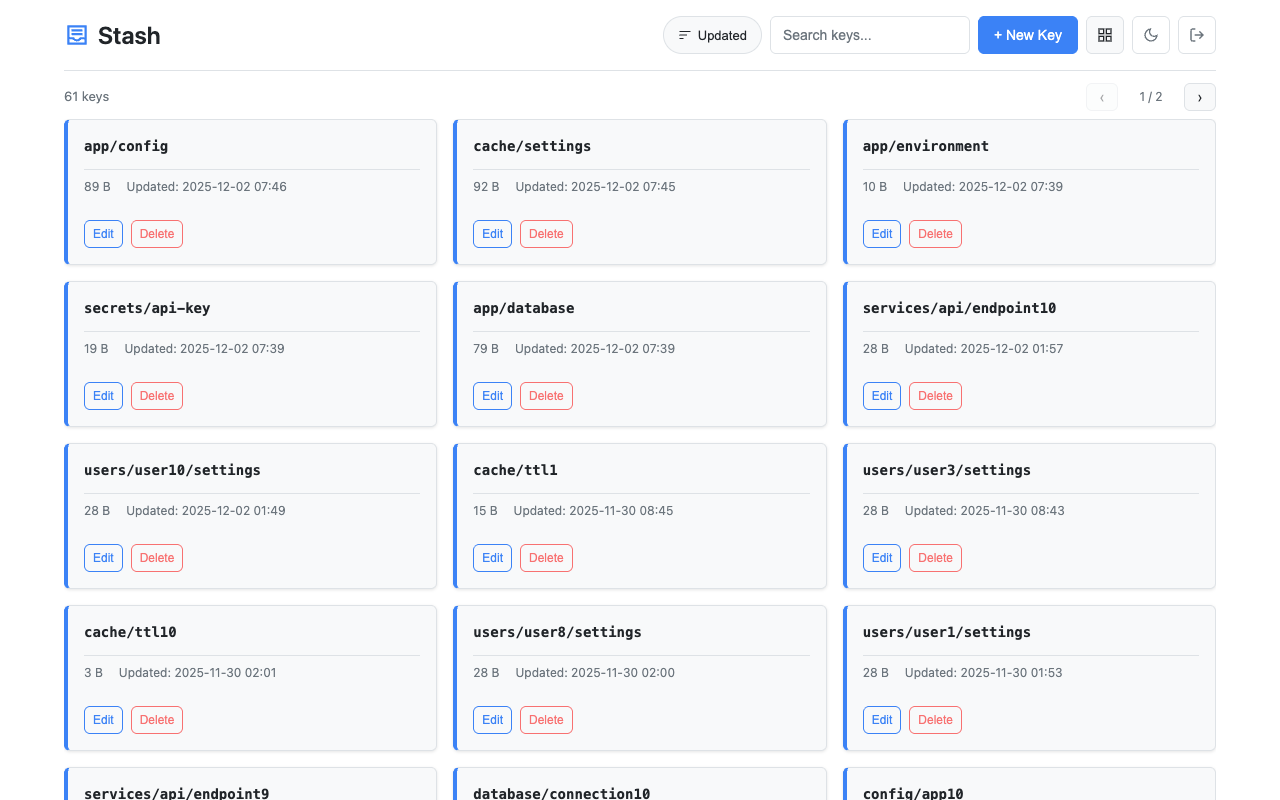
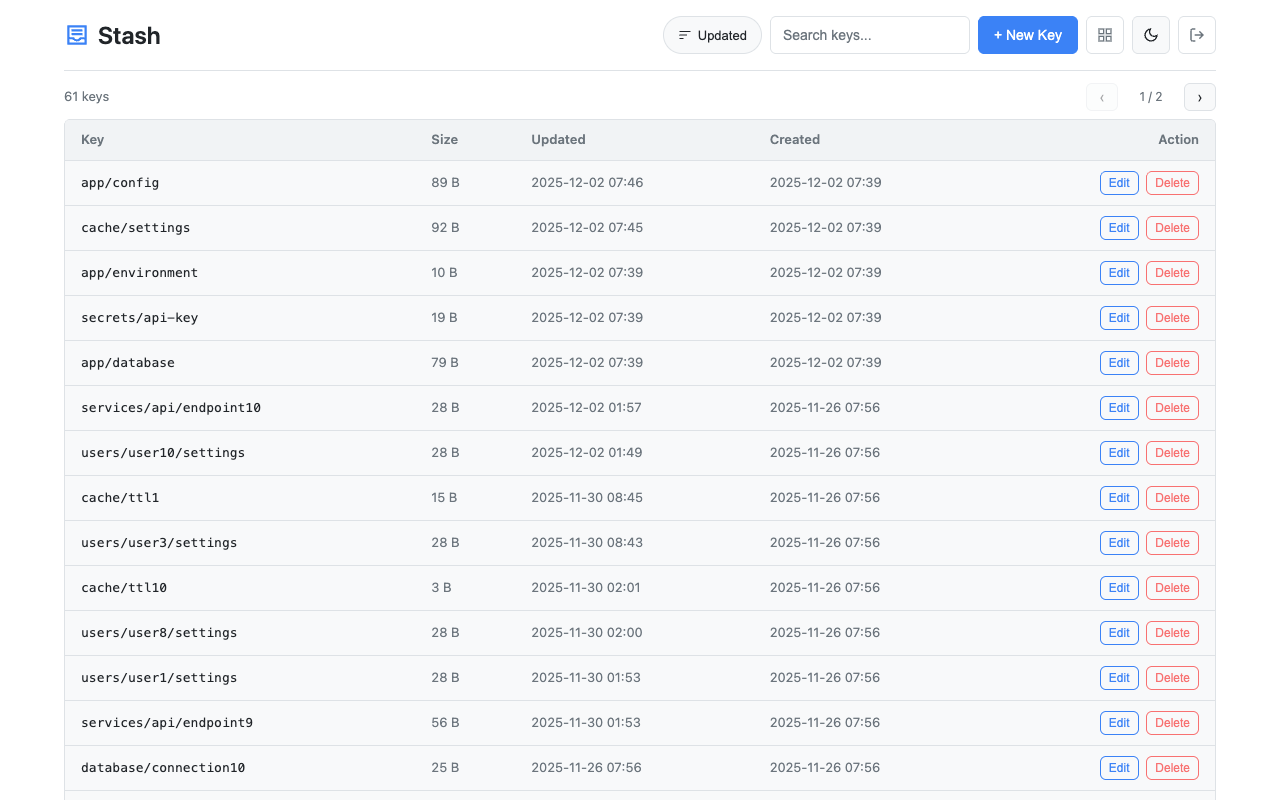
- Card and table view modes with size and timestamps
- Search keys by name
- View, create, edit, and delete keys
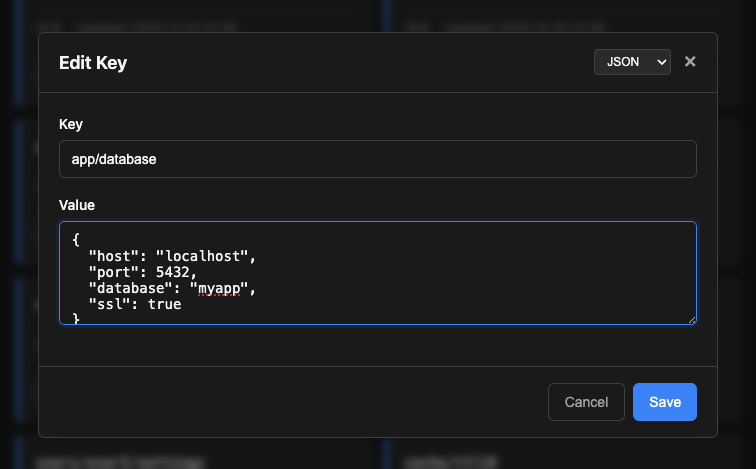
- Syntax highlighting for json, yaml, xml, toml, ini, hcl, shell formats (selectable via dropdown)
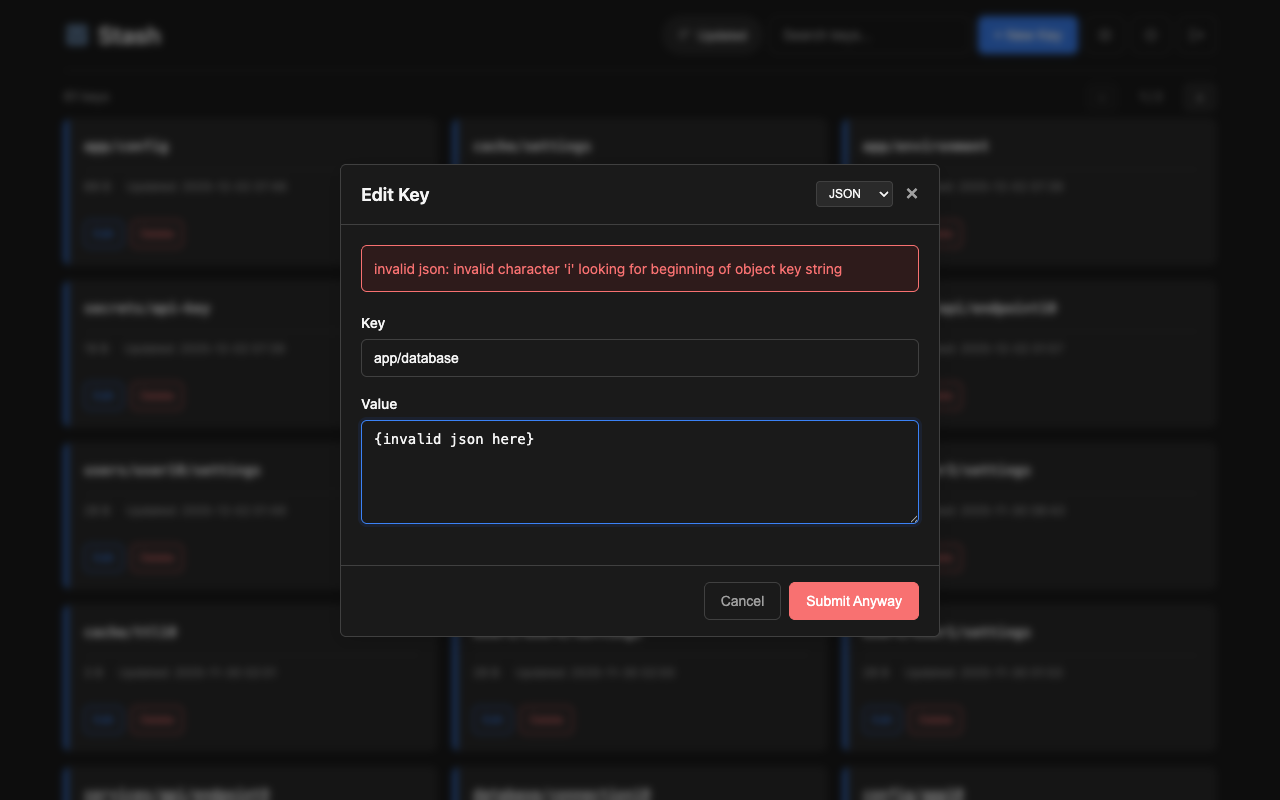
- Format validation for json, yaml, xml, toml, ini, hcl (with option to submit anyway if invalid)
- Binary value display (base64 encoded)
- Light/dark theme toggle
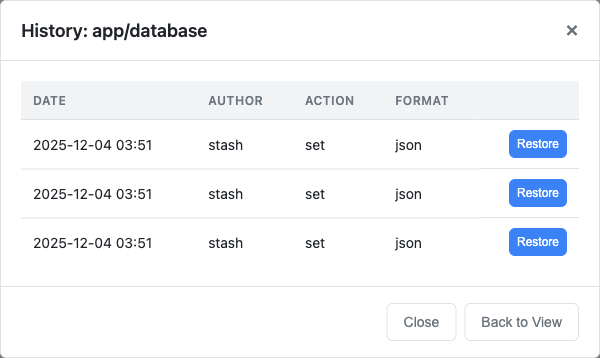
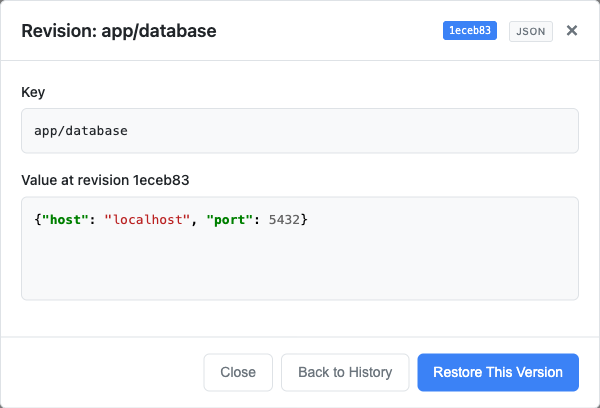
- Key history viewing and one-click restore to previous revisions (when git versioning enabled)
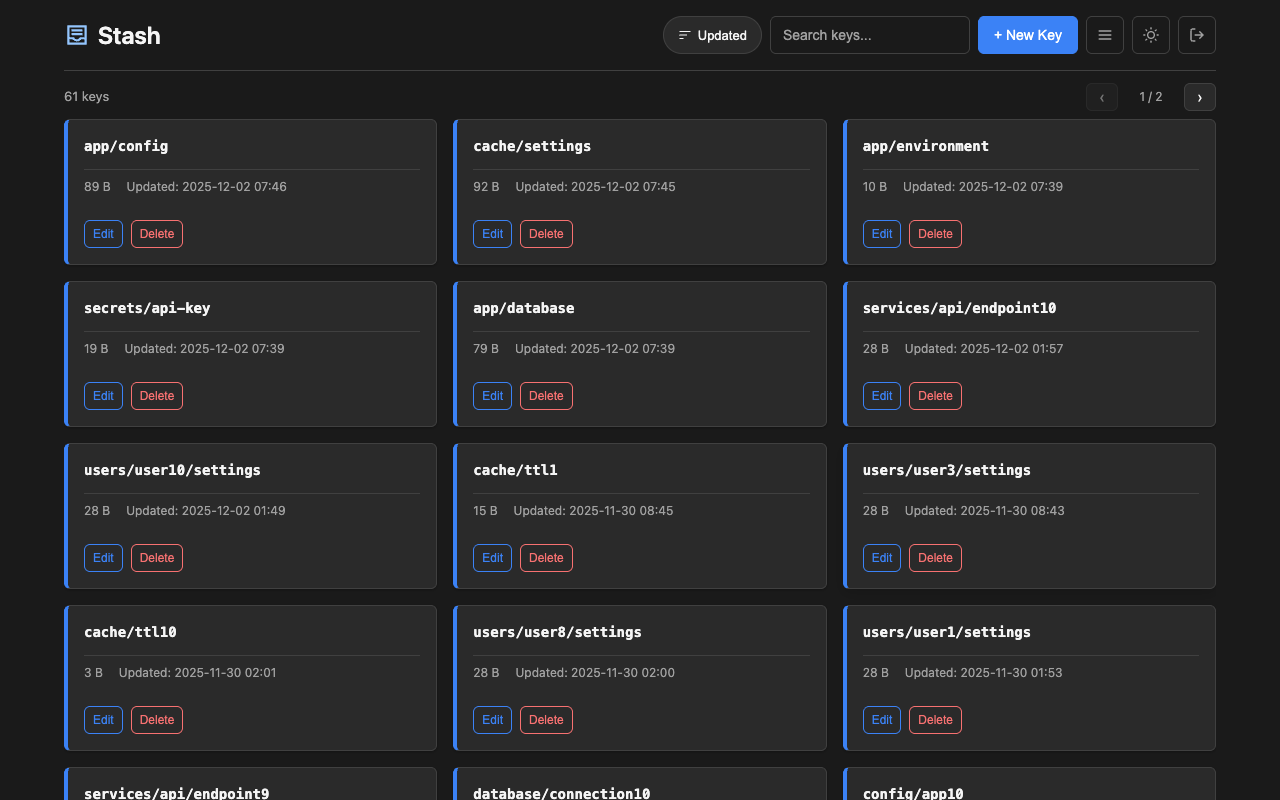
More screenshots
Dashboard - Dark Theme (Table View)
Dashboard - Light Theme (Card View)
Dashboard - Light Theme (Table View)
View with Syntax Highlighting (JSON)
View with Syntax Highlighting (YAML)
Edit Form with Format Selector
Edit Form with Validation Error
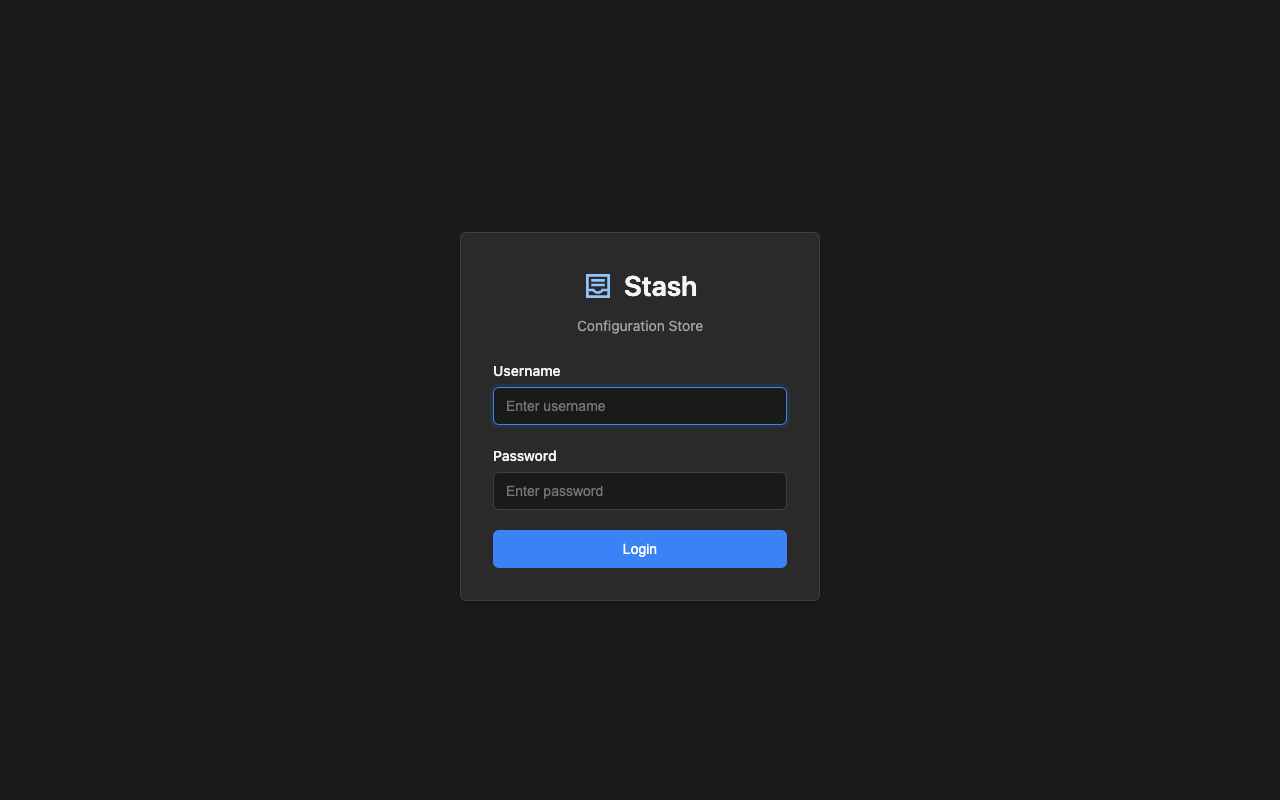
Login Form
Key History (Git Versioning)
Revision View
Examples
# set a simple value
curl -X PUT -d 'production' http://localhost:8080/kv/app/env

# set JSON configuration
curl -X PUT -d '{"host":"db.example.com","port":5432}' http://localhost:8080/kv/app/config/database

# get the value
curl http://localhost:8080/kv/app/config/database

# delete a key
curl -X DELETE http://localhost:8080/kv/app/env
Docker
SQLite
With Git Versioning
docker run -p 8080:8080 -v /data:/srv/data ghcr.io/umputun/stash \
server --db=/srv/data/stash.db --git.enabled --git.path=/srv/data/.history
PostgreSQL with Docker Compose
version: '3.8'
services:
  stash:
    image: ghcr.io/umputun/stash
    environment:
      - STASH_DB=postgres://stash:secret@postgres:5432/stash?sslmode=disable
    depends_on:
      - postgres
    ports:
      - "8080:8080"

  postgres:
    image: postgres:16-alpine
    environment:
      - POSTGRES_USER=stash
      - POSTGRES_PASSWORD=secret
      - POSTGRES_DB=stash
    volumes:
      - postgres_data:/var/lib/postgresql/data

volumes:
  postgres_data:
Production Setup with SSL
See docker-compose-example.yml for a complete production setup with: - Reproxy reverse proxy with automatic SSL (Let’s Encrypt) - PostgreSQL database - Authentication enabled
# copy and customize the example
cp docker-compose-example.yml docker-compose.yml

# set your domain in SSL_ACME_FQDN and reproxy.server label
# create auth config file with users and tokens
cat > stash-auth.yml << 'EOF'
users:
  - name: admin
    password: "$2a$10$..."  # generate with htpasswd
    permissions:
      - prefix: "*"
        access: rw
EOF

# set auth file path in .env
echo 'STASH_AUTH_FILE=/srv/data/stash-auth.yml' > .env

# start services
docker-compose up -d
Notes
- Concurrency: The API uses last-write-wins semantics. The Web UI has conflict detection - if another user modifies a key while you’re editing, you’ll see a warning with options to reload or overwrite.
License
MIT License - see LICENSE for details.